The assertion that Georgia holds the distinction of being the homeland of wine is a theory that has garnered significant support over time. The Georgian academic community, drawing upon extensive archaeological, ethnographic, and folkloric data, posited that Transcaucasia, particularly the territory of Georgia, represents the oldest area for both viticulture and winemaking. This theory is further substantiated by the continuous and diverse folk traditions deeply intertwined with wine and viticulture.
In the 1980s, the renowned writer Hugh Johnson lent his voice to this proposition, identifying Georgia as the probable origin of wine in his seminal work, Vintage: The Story of Wine. While these early claims drew on a wealth of evidence, they remained largely speculative due to the absence of precise laboratory analysis. However, recent scientific advancements have provided compelling confirmation. Biomolecular research conducted on 8,000-year-old clay vessels, known as qvevri, unearthed in Georgia, has revealed the presence of organic acids unequivocally characteristic of wine.
This remarkable discovery, dating back to the Neolithic period (6th millennium BCE), has firmly placed Georgia on the global map as a pivotal location for wine connoisseurs and historians alike. The culture of wine in Georgia is not merely a historical footnote; it is inextricably linked to the nation's history, its sense of identity, and the rhythms of everyday life. The unique Georgian tradition of crafting wine in qvevri, a practice that has persisted for eight millennia, reflects this enduring connection and has earned recognition from UNESCO as an intangible cultural heritage.
This report will delve into the multifaceted reasons supporting Georgia's claim as the cradle of wine, exploring mythical narratives, linguistic roots, archaeological findings, geographical advantages, climatic suitability, and enduring ethnographic traditions.
Mythical Foundations: Wine as a Divine Gift in Georgian Lore
Georgian folklore is replete with myths and legends that elevate wine from a mere beverage to a symbol of divine favor and cultural heritage. One particularly popular legend recounts a time when God was distributing lands to the various peoples of the world. The Georgians, engrossed in a feast where wine flowed freely, arrived late. Upon explaining their tardiness, God, delighted by their evident love for wine and celebration, bestowed upon them the special piece of land he had reserved for himself. This myth underscores the profound and almost predestined connection between the Georgian people and their land, believed to possess the finest soil and climate for cultivating grapes.
The antiquity of Georgian viticulture is further echoed in the legend of Prince Badem, son of King Shamiram. According to Persian and ancient Georgian traditions, Prince Badem once saved a phoenix from a deadly serpent. In gratitude, the mythical bird brought grape seeds to the king. Recognizing the potential for pleasure and prosperity, the king ordered these seeds to be sown, leading to the cultivation of vineyards across the land. Interestingly, the tale notes that the phoenix flew to Persia from the north, aligning with the South Caucasus in regional geography, further resonating with the scientific hypothesis that Georgia is the original homeland of wine.
The sacral role of wine in ancient Georgia is also evident in the reverence for Aguna (or Angura), the ancient Georgian deity associated with wine, vineyard fertility, and the prosperity of crops. This deity epitomizes the spiritual and cultural significance of viticulture in the region. Notably, the Persian word for "grape" — angur — hints at ancient cultural exchanges centered around wine. Georgian folklore even recounts that God, while residing in Georgia, created wine as a divine gift — offering humanity a taste of heaven on Earth.
The Language of Wine: Etymological Roots and Global Connections
Linguistic analysis provides compelling evidence for Georgia's role as the cradle of wine. A prominent theory suggests that the word "wine" in many Western languages can be traced back to the Georgian word ghvino (ღვინო) or its variant gvino. This Georgian term originates from the verb ghvivili (ღვივილი), meaning "to boil," "to ferment," and "to flourish," reflecting an early understanding of the transformation inherent in winemaking.
Comparing ghvino to ancient words for wine in other languages reveals striking connections. Latin has vinum, Greek uses oinos, and Hebrew features yayin. Some linguists propose a link to the Proto-Indo-European (PIE) root wéyh₁ō, meaning "wine" or "vine." While scholarly debate continues over whether the term moved from Proto-Kartvelian into Indo-European languages or vice versa, the strong resemblance points to a shared linguistic heritage likely rooted in the Caucasus region.
The Kartvelian language family also has a rich vocabulary related to viticulture, with terms like marani (wine cellar), qvevri (traditional clay vessel), and chacha (the pomace or distilled spirit from grape skins). Even the Georgian alphabet, with its elegant, tendril-like curves, has been poetically linked to the shape of grapevines, echoing wine's deep roots in the culture.
Archaeological Evidence of Early Winemaking
The most compelling evidence for Georgia's claim as the cradle of wine lies in its archaeological record. Groundbreaking discoveries at Neolithic sites such as Gadachrili Gora and Shulaveris Gora, located about 50 kilometers south of Tbilisi, unearthed 8,000-year-old pottery jars containing the earliest biomolecular traces of grape wine residue ever found. Chemical analysis of these jars, some decorated with grape motifs, revealed the presence of tartaric acid, a key indicator of wine.
These findings push back the known history of grape winemaking by at least 600 to 1,000 years compared to earlier discoveries in Iran, firmly establishing Georgia as the world's earliest known winemaking region.
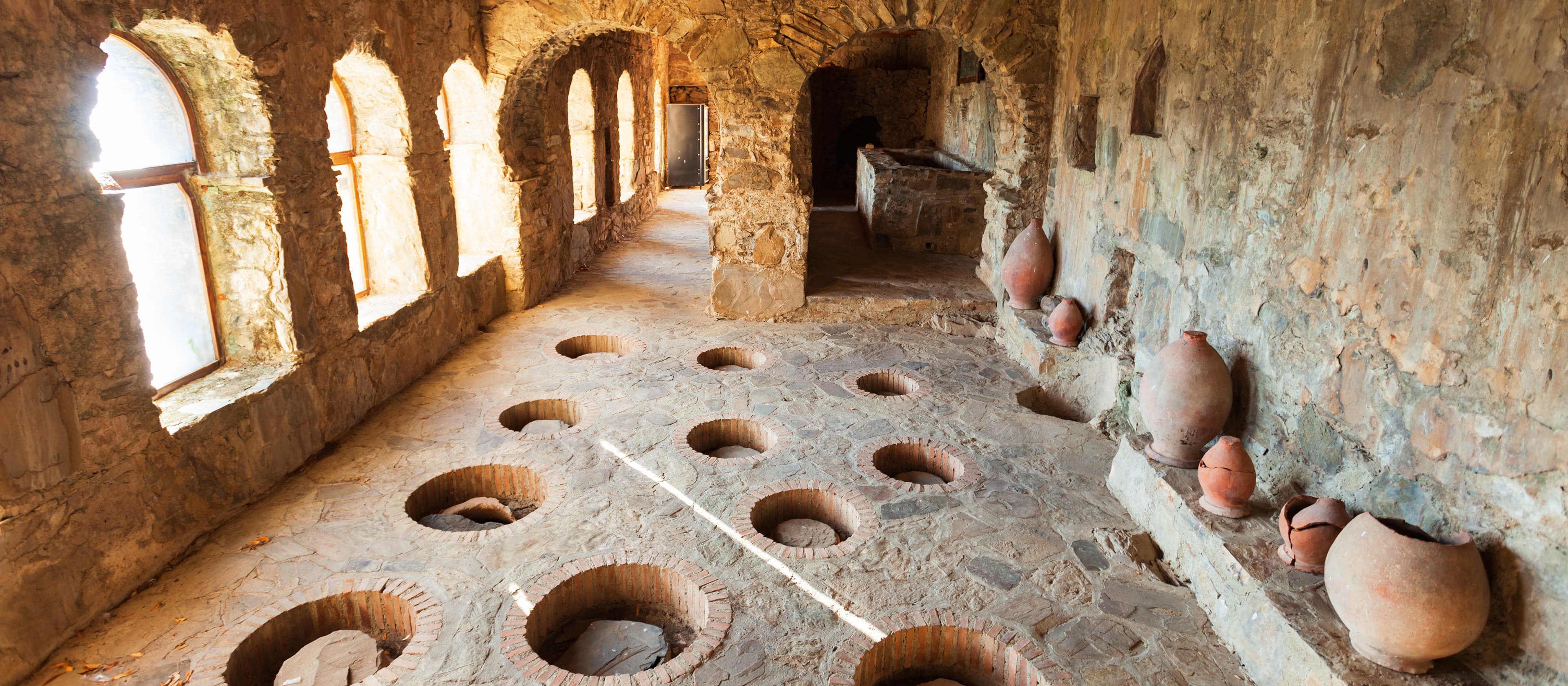
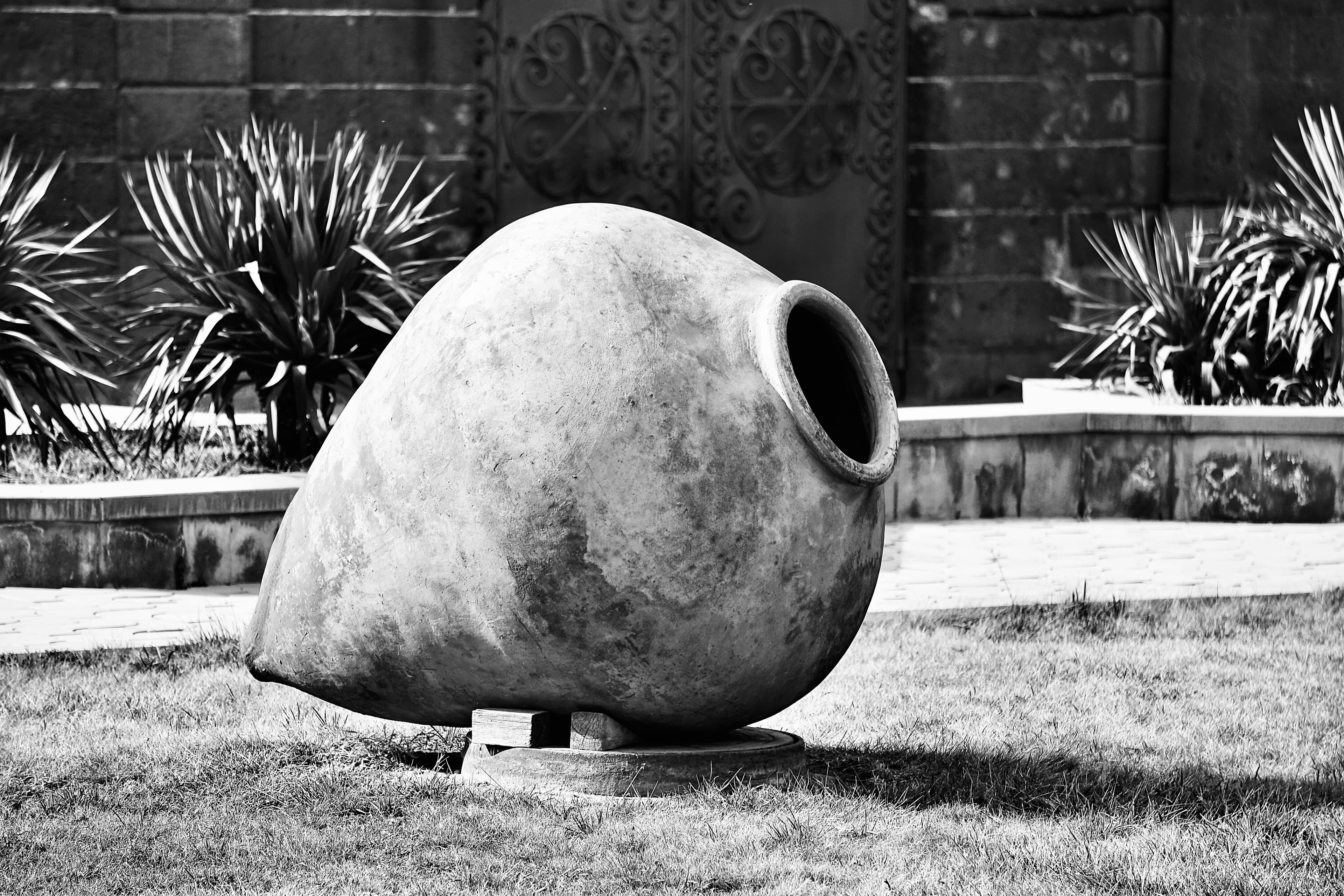
Further support comes from ancient grape seeds excavated at sites like Dangreuli Gora and Khramis Didi Gora, showing early signs of domestication. The widespread presence of qvevri — large, egg-shaped earthenware vessels used for fermenting and aging wine — in archaeological contexts from the 6th millennium BCE onward further demonstrates an unbroken winemaking tradition.
Artifacts from the 3rd and 2nd millennia BCE — including silver, gold, and bronze vessels adorned with grapevine motifs — testify to the cultural importance of wine in ancient Georgian society. Wine jugs and cups found in tombs underscore wine's role in spiritual and social life, linking the living to the divine and the afterlife.
Geography and Climate: Why Georgia Suits Grapevines
Georgia's geographical and climatic conditions have been exceptionally favorable for viticulture since antiquity. Lying between the Greater and Lesser Caucasus mountain ranges, Georgia's landscape offers fertile valleys, well-drained slopes, and protective terrain ideal for cultivating grapevines.
The proximity of the Black Sea moderates the climate, creating warm, moist conditions favorable to viticulture. Meanwhile, the mountains shield Georgia from harsh continental and desert climates, providing stability and mildness — factors crucial for growing delicate vines.
The region's diverse soils further enhance its viticultural bounty. Different regions within Georgia have unique terroirs, each imparting distinctive qualities to the grapes grown there. Studies of ancient climate patterns confirm that during the Neolithic period, the South Caucasus enjoyed a mild, well-watered climate that was particularly suited to Vitis vinifera, the Eurasian grapevine species that remains the basis of nearly all wine produced today.
Georgian Winemaking Practices That Are Still Alive Today
The traditional Georgian method of winemaking, using qvevri, represents one of the world's oldest continuous winemaking practices. Crushed grapes, along with their skins, seeds, and stems, are placed into the large clay vessels, which are then buried underground. This allows fermentation and aging to occur naturally at a stable temperature, preserving the wine's distinctive character.
Tools like the satsnakheli (traditional grape press), copper vessels such as avgardani and chapi, and specialized cleaning instruments like the krazana and sartskhi evolved alongside qvevri winemaking. Regional variations such as the Kakhetian and Imeretian methods further showcase the depth and diversity of Georgia's oenological heritage.
The survival of these ancient practices, now recognized by UNESCO, reaches well beyond nostalgia for the past. Georgian qvevri wine has inspired a global movement among natural, organic, and biodynamic winemakers seeking authenticity and purity in their craft.
Part of Everyday Life: The Significance of Wine in Georgian Society
Wine permeates every aspect of Georgian life — religious, social, artistic, and economic. The marani (wine cellar) often holds sacred status in Georgian homes, serving as the setting for baptisms, weddings, and religious ceremonies. Ancient practices of naming the best wines after saints and burying qvevri in churchyards reflect the sacred relationship between wine and faith.
Georgia's legendary hospitality is symbolized by the abundance of wine at every feast, none more so than the traditional supra. During these gatherings, led by a tamada (toastmaster), wine becomes a medium for sharing profound stories, values, and expressions of identity.
Artworks, festivals like Tbilisoba, and ancient economic exchanges — exporting wine to Greece, Rome, Persia, and Jerusalem — further highlight wine's role as a cornerstone of Georgian civilization.
Bringing the Evidence Together
The arguments supporting Georgia's claim as the cradle of wine are varied, but together they make a strong case. Archaeology provides direct proof, linguistics adds strong supporting connections, and mythology shows just how far back the reverence for wine goes.
Georgia's remarkable natural advantages and the uninterrupted continuity of traditional winemaking practices — embodied most vividly by the qvevri — serve as living links to humanity's earliest experiments with wine. Wine's deep cultural integration, permeating religion, hospitality, art, and economy, underscores its profound and enduring significance.
Conclusion: Affirming Georgia's Place as the Cradle of Wine
Based on the comprehensive evidence presented, the claim that Georgia is the cradle of wine stands as a robust and compelling assertion. The archaeological record, linguistic connections, mythical narratives, favorable geography, enduring traditional practices, and deep cultural integration all affirm Georgia's pivotal and foundational role in the history of wine. This legacy reaches beyond history alone — it continues to shape the global wine world today, offering a living tradition with roots that stretch back to the very dawn of civilization.