How I fell in love with the city of poetry, gossip, and music
Where I lived in Kutaisi
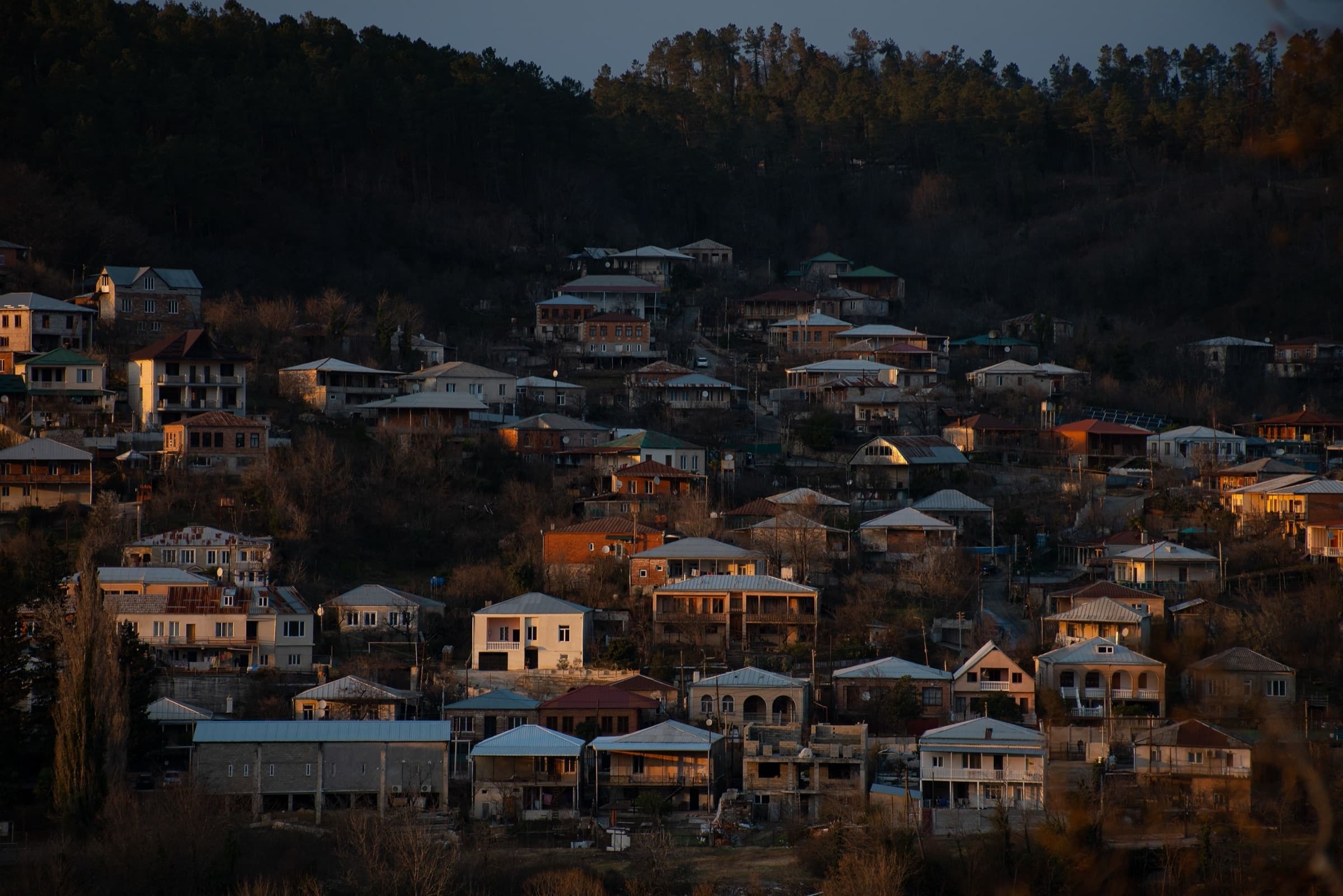
My mother got appointed to a high government position in Kutaisi, Imereti. She had just broken her arm, so I went with her to help her settle. Over the course of three years she spent working there, I split my time between my hometown and Kutaisi, not only because of my mom but also because I fell in love with this small city.
We rented a three-bedroom apartment in an old brick building with a green yard in front of it, just on the brink of the city. Still, it only took me five minutes to drive to the city center.
On the first day at her new job, I drop my mom off and then wander around the city with nothing to do.
The coffee shop on the small street of Kutaisi
I park the car in the city center and walk into the cafe I notice across the street, “Our Cafe”. It is located on a small paved street along with a Women's Gymnasium from 1847, now Public School N3, a puppet theater, and the city's oldest pharmacy, Pharmacy N4. Despite its prime location, Our Cafe is mostly empty. Kutaislebi, or the residents of Kutaisi, love coffee. The coffee snob in me notices that theirs is bitter, burnt, and way too hot. Yet Kutaisi becomes the only city where I don't complain about poor coffee-making.
The cafe's huge tables are surrounded by knick-knacks from the olden days. For Kutaisi, 'Olden Days' are the turn of the 20th century. In the 1910s and 1920s, during its brief independence from the Russian Empire and before Soviet occupation, Georgian poetry and culture florish with their roots in this very city.
The poets of Kutaisi and their fate
But in 1937, the year of the Great Terror, two of the city's most prominent poets, Titsian Tabidze and Paolo Iashvili, die. Paolo, awaiting his arrest, shoots himself in the Writers' Union building in Tbilisi. Titsian refuses to disown the persecuted Paolo and is arrested in Tbilisi. For almost two decades, his family sends him parcels in exile, unsure if he is alive or if the rumors are true and he has been left in the winter storm in the steppes on the way to Siberia. Almost twenty years later, it is revealed that he had been executed two months after the arrest. His grave does not exist. But their deaths are linked with Tbilisi, the capital city, not Kutaisi.
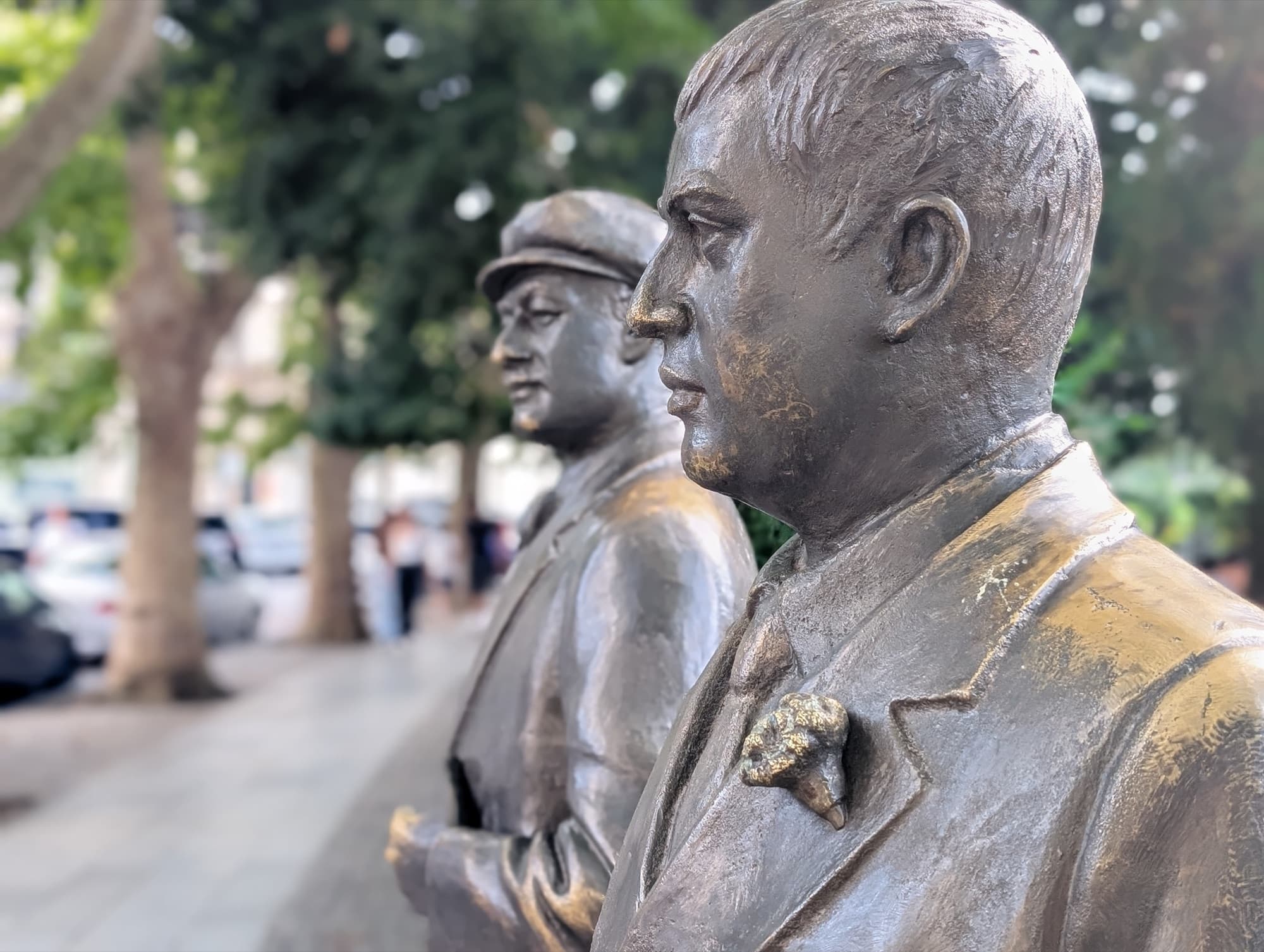
Kutaisi is the city where they grew up and started creating. The city refuses to define them by their deaths. Instead, they are a source of pride and joy here. From the cafe, I walk through the arch and across the square to the First Public School, where the poets studied. Near the school stand the statues of Paolo and Titsian side by side, looking at their city, as Paolo called it, “painted on the full moon.”
The secret stairs behind the Golden Canopy
Behind the school, I notice a giant sycamore tree and think it must be one of those trees that are hundreds of years old. The long, heavy branches of the tree hang over a house from the 18th century, The Golden Canopy.
After united Georgia was divided in medieval times, this place held residences of Western Georgia's kings up until its last king. From the fifteenth century onwards, depending on the state of the country and the power of the reigning king, the place grew into a walled complex, fell to ruin, was rebuilt, and shrank to this one surviving house.
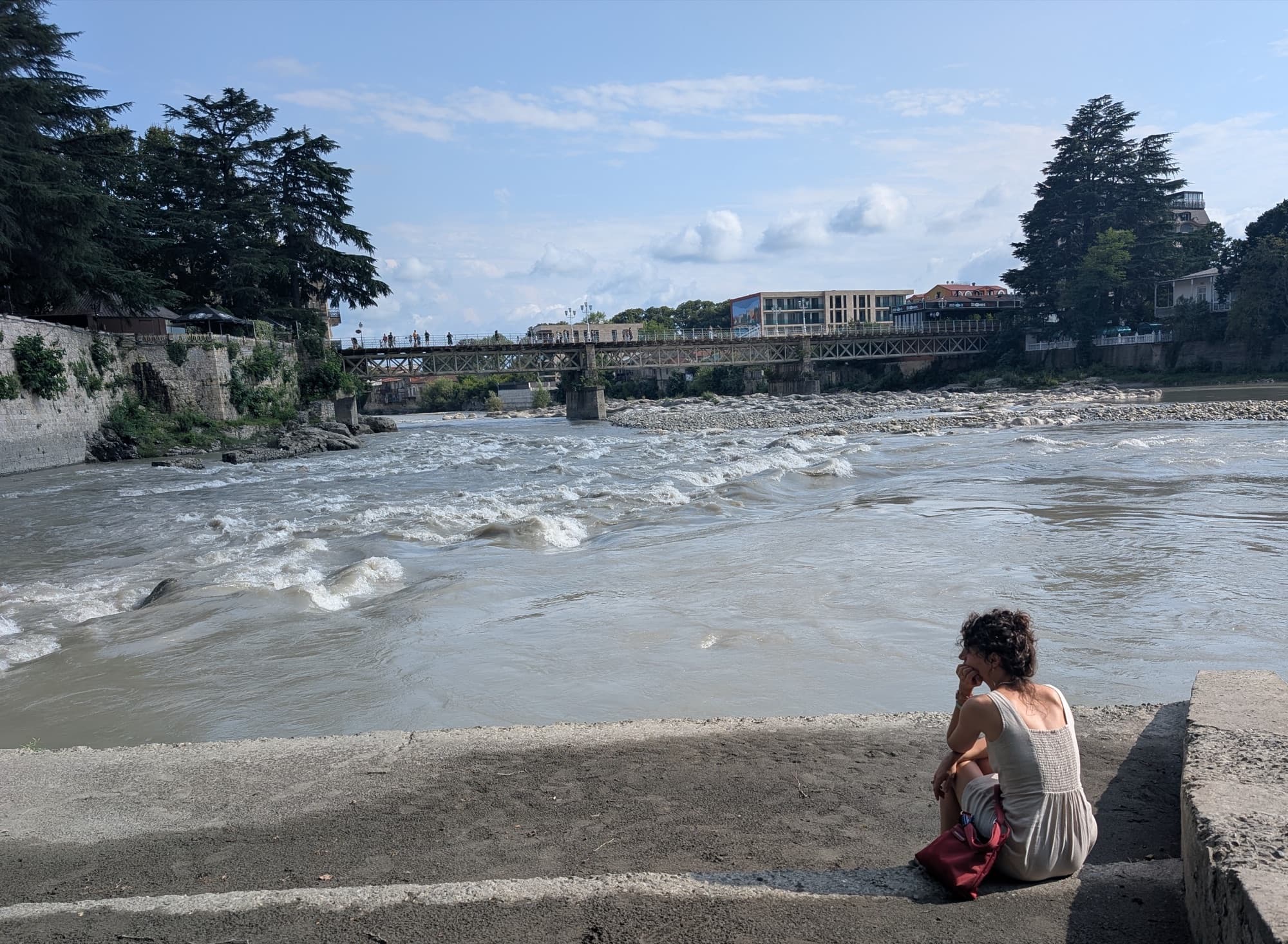
I walk around the yard and come across a hidden spot with wide stairs that go all the way down to the river Rioni behind the residence. The bottom step is covered in water. The stairs are empty. I sit down and contemplate the unfair fate of the country and its kings. I imagine myself a character in a slow-paced film. My own vanity amuses me, and I giggle.
The White Bridge and The Extraordinary Exhibition
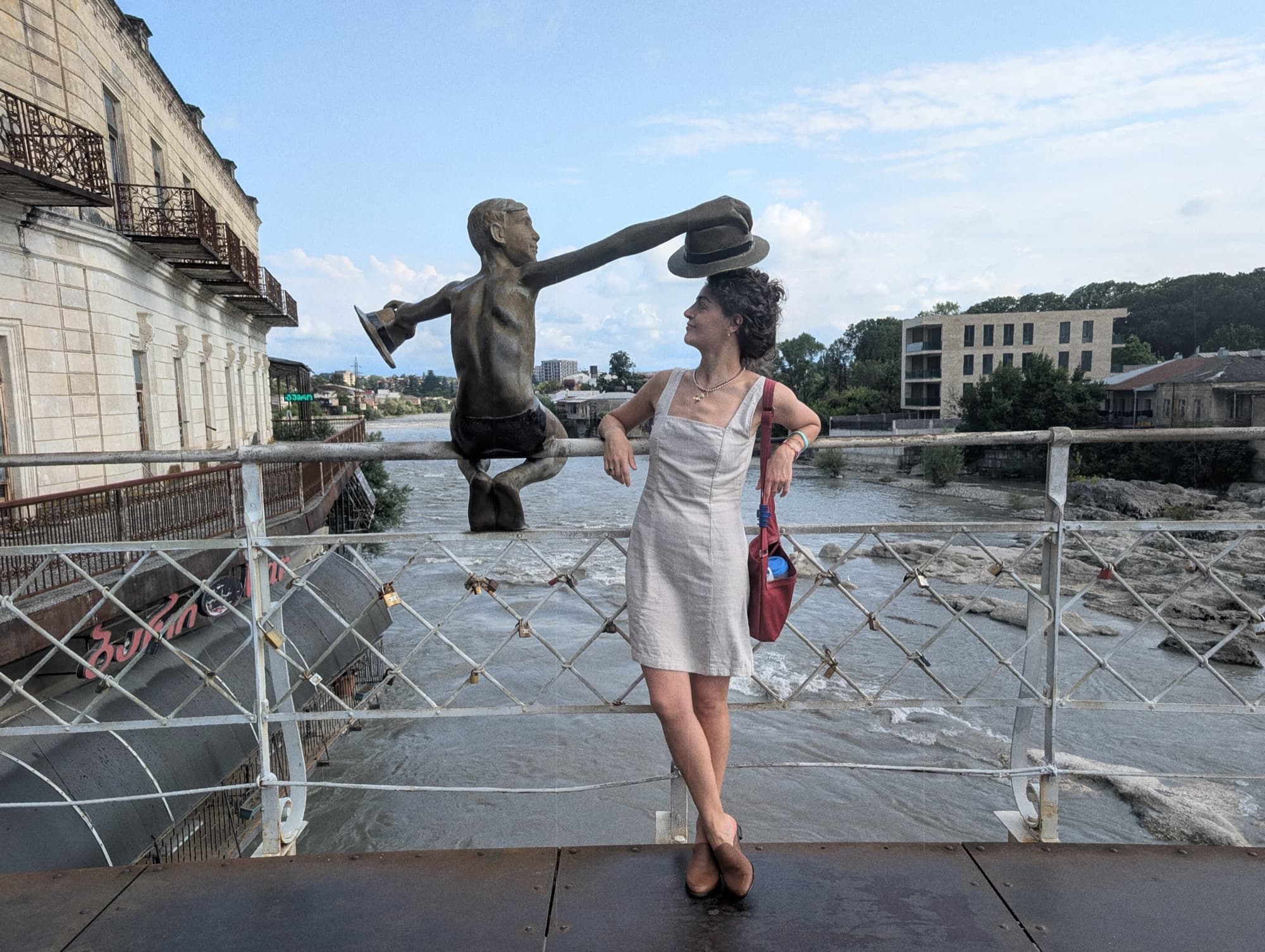
From the steps, I can see The White Bridge. It is the symbol of the city, the way the Golden Gate Bridge is the symbol of San Francisco. On the bridge, there's a statue of a boy holding a hat and about to jump into the river. The boy is a character from the film “An Extraordinary Exhibition” by Eldar Shengelaia. The film is about a sculptor who starts making gravestone busts to support his family. When one day he visits the local graveyard, he realizes it's an extraordinary exhibition of his work. In one of the scenes in the film, people jump from the bridge and into the river. They sprawl on the white stones in the middle of the river to catch their breath and encourage the ones still on the bridge to jump.
This scene, to me, embodies the spirit of the city. Artists and poets jumping off of the bridges into the river, cheerful yelling, despite the struggles, and all of it within five minutes of walk.
Kutaisi Park and the Ishkhneli Sisters
I walk back to the paved street that is my base camp. On the left of the cafe, the Opera House, with thirteen Roman-style sculptures on the roof, overlooks Boulevard, or the central park of the city.
In the park, I stop at the white statue of four women, the Ishkhneli Sisters. Their elongated figures look young and dreamy. In reality, they were almost middle-aged, with long traditional four braids hanging to the waist, clad in long white dresses. Eternal virgins singing love songs and, like Vera Lynn, cheering up the WWII soldiers.
Harder than any illness is love. Oy, for a lover, oy, even the light is dark. Oy, for a lover, oy, even the light is dark.
Gossip in Kutaisi library
I cross the park and walk into the library to get a membership card. The librarian with impossibly blue eyeshadow and yellow hair notices my dialect and asks me if I'm from Tbilisi and what I'm doing in Kutaisi. She fills out my card manually and listens to me carefully. “Your mother must be making good money to move here from the capital.” I smile at her and fight my urge to tell her everything. We stare at each other as she holds my library card hostage.
Every town that loves coffee loves gossip. The smaller the town, the faster the word spreads. A British spy visits Kutaisi and knocks on the door. A woman opens the door. “Miss, don't you think that the clouds today — ” The woman interrupts him: “I don't know about the clouds, but the spook you are looking for lives upstairs.”
“Give her the card, woman” — another librarian interrupts our staredown. My librarian reluctantly slides the card to me, and I run down the stairs of the library victorious but still looking behind my back.
Buying jewellery
Our next-door neighbour, a woman with big breasts and a bigger smile, whose name would loosely translate as Inky, sells jewelry in the “Gold Market” next to the library. I walk in to look at Soviet rose gold pearl earrings and Italian yellow gold knock-off Cartiers. Kutaislebi are very stylish. No occasion is too small for dressing up and adorning a neck with gold chains. Here I perceive this as a small gesture from Kutaislebi that maintains the city's cultural past rather than showing off. Everything that would annoy me in another city fills me with admiration here. But maybe it's because I'm just a visitor here. Inky is friends with two other women running their stands next to hers. Both have yellow hair. Inky whispers in my ear that it doesn't matter who I buy from as long as I find what I like.
Kutaisi bazaar (market)
When I have circled the city center, I can finally go to the place I look forward to visiting in every city, the bazaar. It surprises me to see how small and clean this bazaar is relative to the huge and smelly one I'm used to in the city. I hover over the stand of greens and tkemali, the traditional Georgian sauce, and inhale the scent of cilantro. The woman selling the greens squirts water on them out of a plastic bottle with tiny holes in its lid. She smiles at me, and I ask her to let me try some of her homemade tkemali. She opens the bottle and pours a little bit in my palm. I lick it. This bizarre way of trying a dressing is how we've bought it forever in this country because every homemade tkemali tastes different and the factory tkemali is garbage. I don't like her dressing, but I buy it anyway because she is so nice to me.
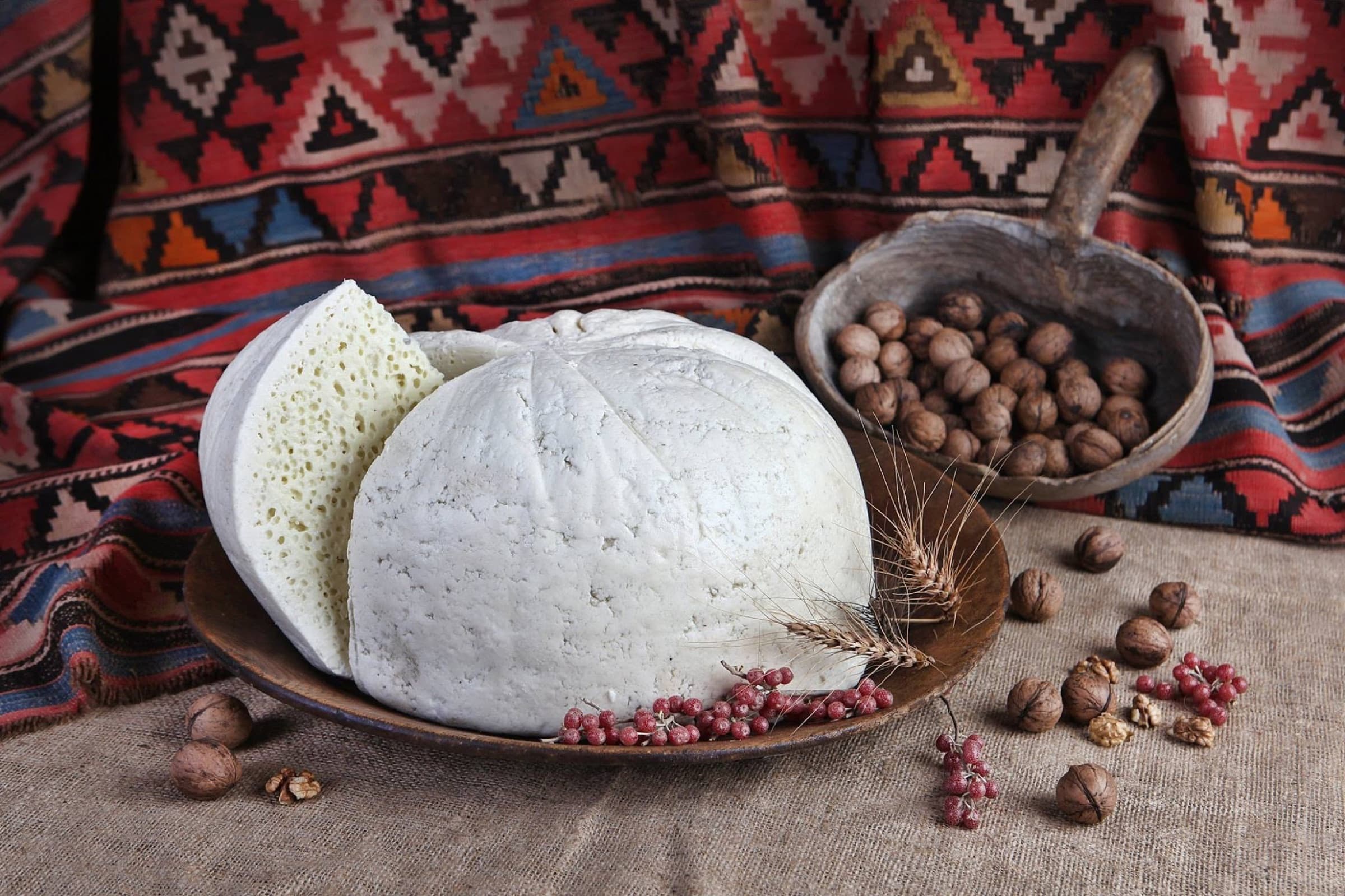
I walk up the stairs and into the cheese section. Kutaisi is the capital of Imereti, a region that is home to Imeruli cheese, the most common Georgian cheese variety. Here too, I ask the seller to let me try a piece from a couple of different cheese wheels. He cuts a tiny triangle out of a couple and lets me try them. I buy a small wheel and finish the rest of my shopping.
The end of the day
When I pick up my mother, we buy a bottle of semi-sweet wine to celebrate her first day at the new job. At home, we drink wine as I fry potatoes and tell her all about my wanderings in the city. Next door, Inky is watering her rose bushes on her big balcony. In the back, the chickens of Inky's husband gently cluck in their coop. We eat the potatoes with some tkemali and cheese. On second thought, the tkemali tastes delicious. As the wine bottle gets emptier, we laugh about the gossip pipelines of Kutaisi and the librarian who has probably, by now, figured out who my mother is and how much money she makes.
Tomorrow I will walk up the hill on the right bank of the city to Bagrati church, look down at the entire city and the snowy mountain ranges far behind. I want to see this city as if on my palm. For what, I don't know yet.