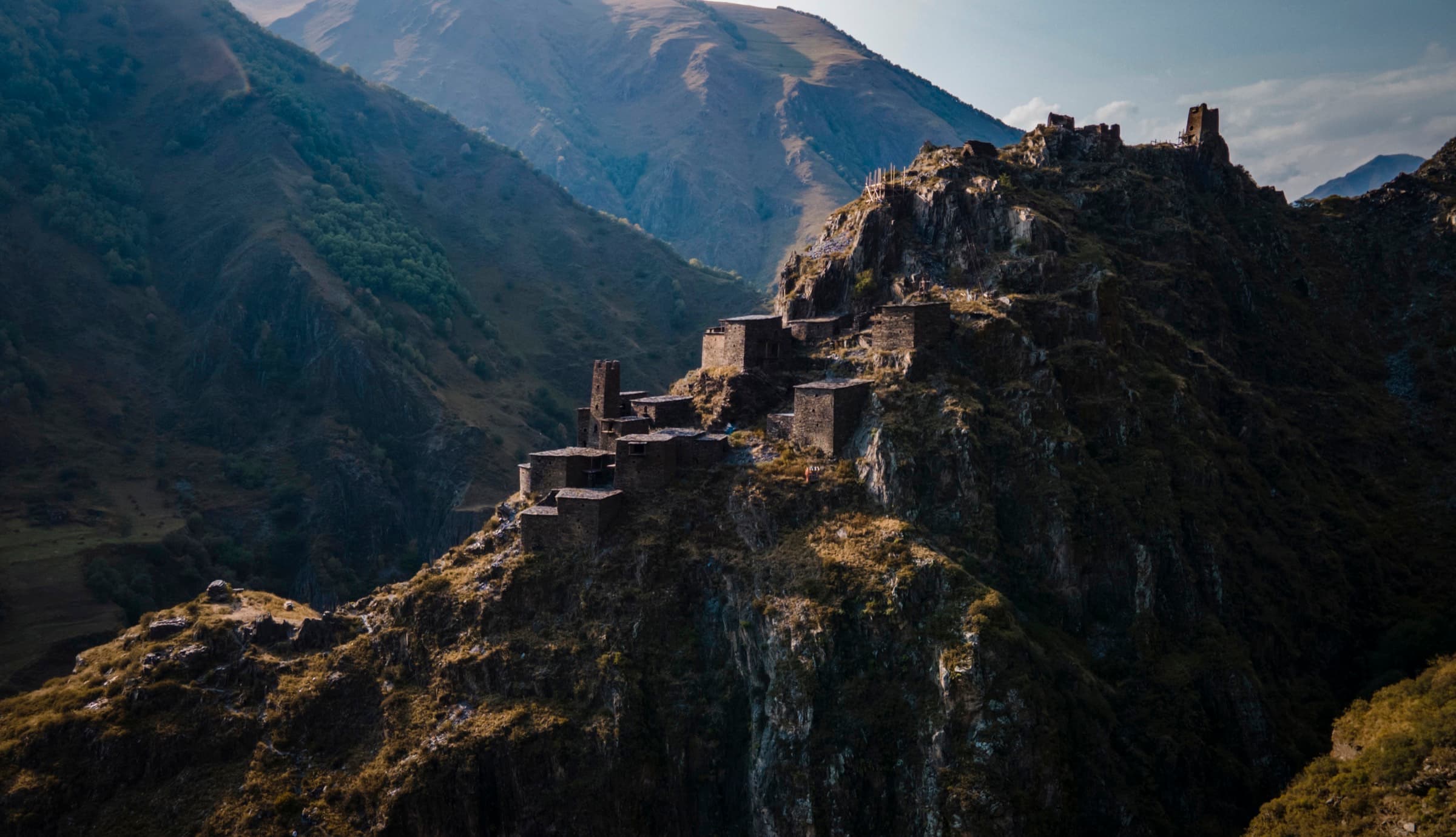
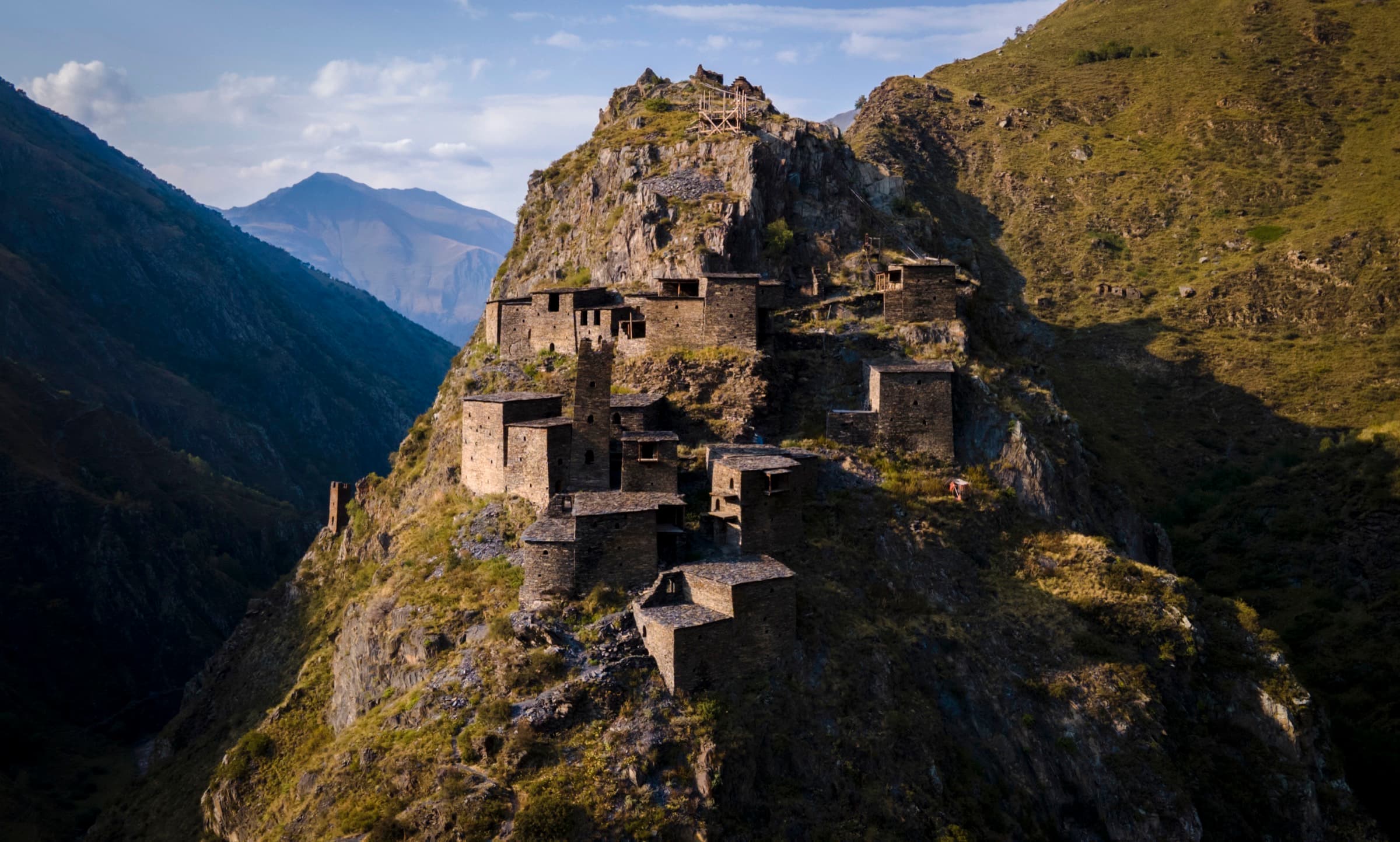
In one of Georgia's most remarkable mountain regions — Khevsureti — perched on a steep, rocky slope at roughly 1,880 meters above sea level, sits Mutso, one of the most striking medieval fortress-villages in all of Georgia.
It's a system of fortified towers built into the cliff in terraces, raised by people on difficult mountain terrain with two purposes in mind: to live, and to defend. For centuries, the Khevsurs watched over the routes coming down from the North Caucasus from exactly this spot, and this is how they guarded their region against enemy raids.
Legends surrounding Mutso
The exact date Mutso was founded is unknown. Based on the archaeological and architectural research we have, the village's main construction belongs to the developed Middle Ages, though the area was most likely settled even earlier.
According to local oral tradition, the village's history is tied to the Shetekauri family. It's only a legend — but Georgia's mountains love their legends dearly, and sometimes those legends end up shaping history too. By one such version, we know that Mutso was built by members of the Shetekauri family. Other tales connect the village to Khevsur warriors, which gives Mutso a special place in the local cultural memory.
Whichever legend you go with, Mutso is considered one of the most fascinating examples of Georgian architecture. The village is built vertically — meaning the structures follow the cliff's natural terraces, which is why the space is used to the fullest. In many cases, the roof of a lower house serves as the yard or a passageway for the house above it. A layout like this wasn't only about saving space; it also made movement easier and, on the other hand, made defense simpler too.
Materials
The builders used local slate stone, quarried directly from the surrounding slopes. Because of this, the structures blend into the natural landscape in both color and texture. On top of that, the local stone stood up well to the high-mountain climate, where sharp swings in temperature, strong winds, and snow were an everyday reality.
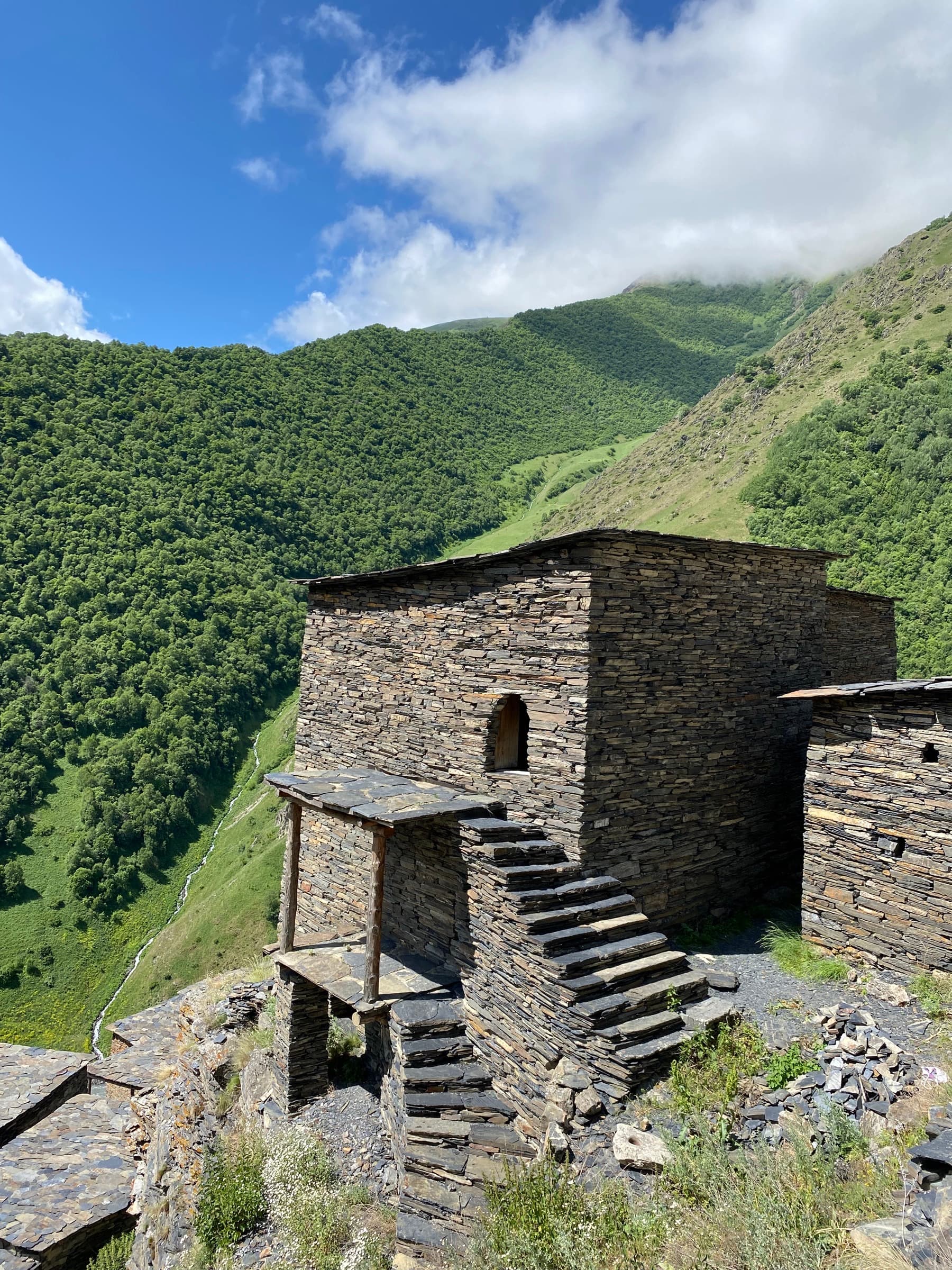
The historic complex includes dozens of fortified dwellings, four battle towers, chapels, crypts, and other auxiliary structures, all forming a single defensive system. The village's layout meant that, if the need arose, the residents could turn the entire settlement into one unified fortress.
One of the most intriguing parts of Mutso is its crypts. According to local tradition, during outbreaks of contagious disease, the severely ill would move into the crypts of their own accord, in order to protect the rest of the village. Even though this story once again rests on oral history, it remains an important part of Mutso's cultural memory to this day.
Abandonment and Revival
From the late 19th century, and especially through the 20th, Mutso's population gradually dwindled. There were various reasons for this. Because of the harsh conditions here, the scarcity of farmland, and the difficult terrain, people were forced to move down to the lowlands little by little. From the middle of the last century, Mutso was almost entirely abandoned, and the stone structures, left without care, slowly fell into disrepair.
Work to preserve Mutso's authentic character began at the state level in 2014. In 2019, the Mutso project was awarded a Europa Nostra prize and became the “Public Choice” in the field of heritage. According to Europa Nostra, 8,500 people voted Georgia the winner, casting their votes online for their favorite achievements in European heritage.
Visiting Mutso Today
Today, Mutso is one of the most popular destinations in Khevsureti for anyone drawn to the history and architecture of Georgia's mountain regions. To reach the village, you'll need to walk a short but steep footpath — or bring a fairly rugged, high-clearance vehicle. And the main sight is at the very top of the village: a fortress-village cut into the sky, arranged in terraces, a wonderful illustration of what life was once like in mountainous Khevsureti. Here, every wall, tower, and narrow passage exists out of practical necessity — first and foremost for safety, for economy of space, and for adapting to the environment. This is exactly what makes Mutso one of the most distinctive examples of mountain architecture not only in Georgia, but across the Caucasus.
And, most importantly, to get to Mutso you'll pass through many more of Khevsureti's unique villages — ones we'll tell you about later. You can plan this journey together with darani.travel.